According to the latest market model report released by Niko Partners, thanks to the expansion of the player base and multidimensional growth in emerging markets, the video game market in Asia and North Africa in the Middle East is expected to break the $100 billion mark in five years.
In 2025, the games market in the two above regions generated $88.9 billion, an increase of nearly 3 per cent over the same period. Niko projected that income growth would exceed 3 per cent in 2026, reaching $91.8 billion, and $103.6 billion in 2030, with a five-year complex annual growth rate of 3 per cent. The total number of players will be close to 2 billion, well above the 1.8 billion in 2026.
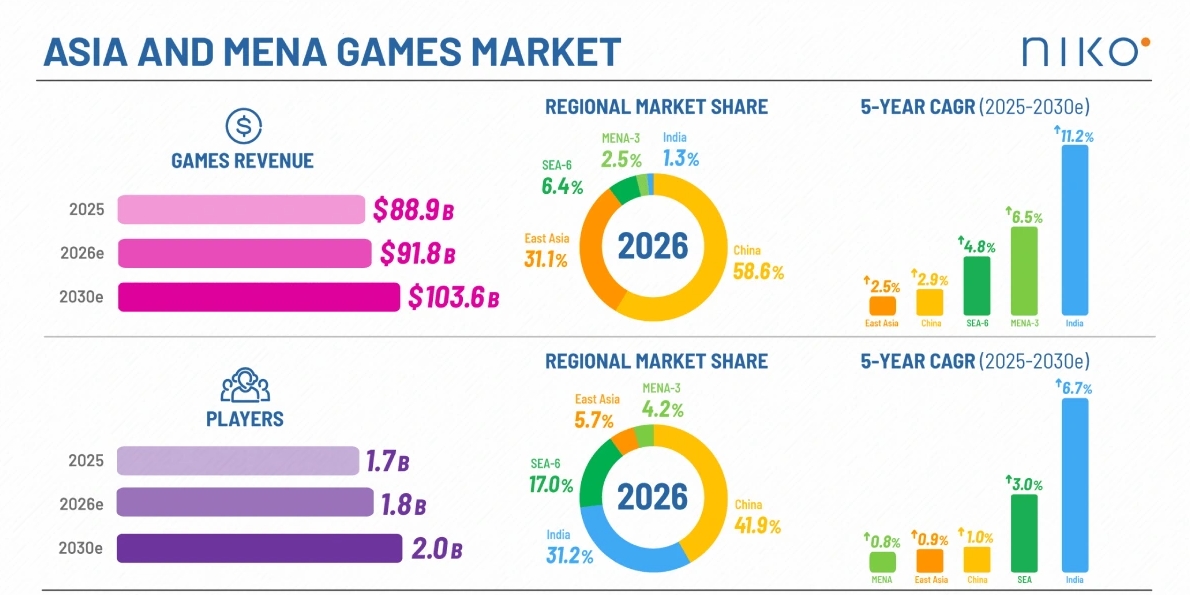
By 2030, China, Japan and the Republic of Korea will account for 89 per cent of total market revenues, about $91.7 billion, but the fastest growing markets are in other regions. The number of Indian players now exceeds 500 million and is expected to become a market of nearly $2 billion by 2030, with a compound annual growth rate of 11 per cent.
In 2030, MENA-3 (Saudi Arabia, the United Arab Emirates and Egypt) players will spend $3 billion, ranking second in income growth, after India, with an increase of $10 per user per year on average over the projection period. In South-East Asia, Thailand is expected to reach a milestone of $2 billion by 2026. The Indonesian market is expected to reach $1.5 billion and the number of players is expected to reach $144 million by 2030, while Viet Nam is expected to have 68 million players during the same period.

In addition, small games in China already account for nearly 20 per cent of mobile game consumption. India ‘ s mobile game player spending is expected to exceed $1 billion by 2027, an increase driven by the diversification of goods other than escape.
At present, the share of female players in Asia and MENA is 42 per cent, up from about 40 per cent the previous year. Five years ago, the percentage of male players in India and MENA-3 was as high as 80%.
The Niko Partners study shows that Asian players are clearly more active at generating AI than Western markets. A growing number of studios report that AI has improved its development efficiency, but players still support AI-aided workflows more than replace core art or marketing assets.