
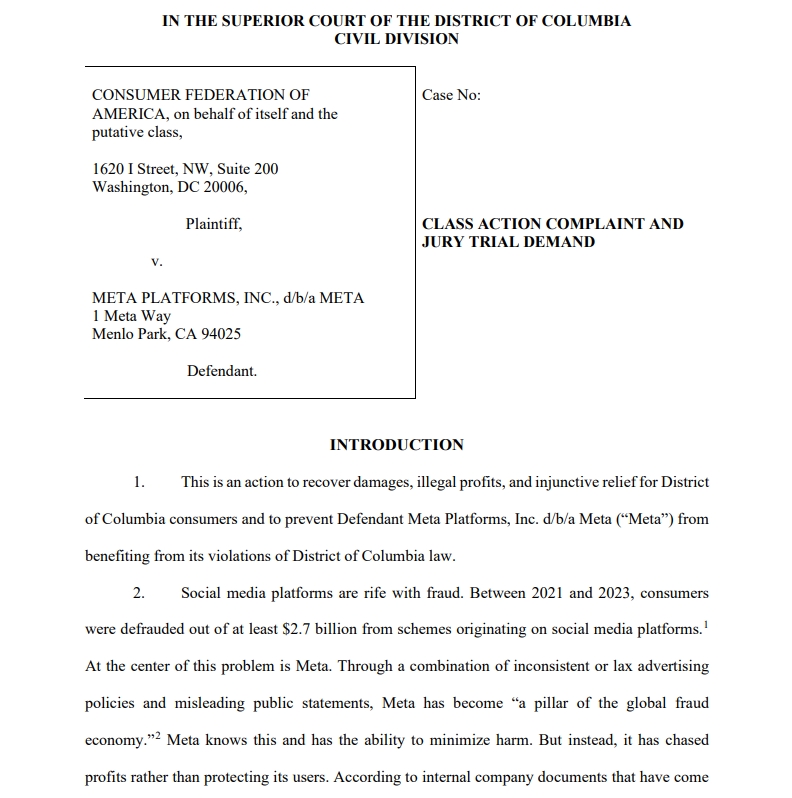
According to the Wireline magazine, a recent lawsuit shows that between 2021 and 2023 consumers lost at least $2.7 billion as a result of fraudulent activities in social media, accusing Meta of playing an important role in facilitating such activities. The American Consumer Union (CFA) filed a class action with the High Court of the District of Columbia today, alleging that Meta had violated the Consumer Protection Procedures Act (CPPA) in the District of Columbia, alleging that it had misled users in terms of platform security, while safeguarding their rights and interests, in pursuit of the revenue from advertising, ignoring the protection against fraud.
According to the petition, Meta’s internal documents forecast that more than 10 per cent (approximately $16 billion) of its revenue in 2024 came from its “fraud and prohibited goods” advertisement on its “Faceground Media Platform (Facebook, etc.). It was further noted that Facebook users were exposed to approximately 15 billion “suspect” fraud advertisements per day, with annualized revenues estimated at $7 billion per year. Most of the basis for the proceedings was described in a Reuters journalist, Jeff Hog, who reported last year. In its November 2025 survey, Reuters consulted Meta’s internal documents and showed that, for at least three years, Meta had failed to detect and contain “a large number of illegal advertisements, which exposed billions of users of Facebook, Instagram and WhatsApp to the risks of fraudulent electricians and investment plans, illegal online lottery and the marketing of prohibited medical products”. The litigation also cited Reuters ‘ s findings on an internal 2023 document, alleging that Meta had failed to fully implement its own anti-fraud security measures. The petition stated that, although Meta had publicly stated that it was “active” in its fight against fraud, the report indicated that the company continued to receive approximately 100,000 valid fraud reports from users every week, 96 per cent of which were either ignored or wrongfully rejected.

CFA also alleged that Meta had imposed internal restrictions on law enforcement operations. Reuters reported that a 2025 paper by Meta indicated that company restrictions on team action could result in a reduction in revenue by more than 0.15 per cent. In addition, the complaint states that even if the Meta system identified advertisers with a 95 per cent probability of fraudulent activity, it would not directly ban them, but would charge “punitive bidding” to allow advertisers to continue to place them at higher cost. The complaint also cites other Reuters reports that Meta tried to evade law enforcement actions against the company. For example, while Japanese regulators used Meta ‘ s publicly searchable advertising library to investigate the existence of fraudulent advertisements on their platforms, Meta allegedly removed some fraudulent advertisements by tampering with the database. As noted in the complaint, the effectiveness of this approach has prompted Meta to include it in a broader “global strategy” aimed at addressing the regulation of multiple jurisdictions, including the United States. The petition also contrasted Meta with competitors like Google. Google reportedly shut down 12.7 million advertisers’ accounts and 5.5 billion “bad advertising” in 2023. By contrast, Meta removed 134 million “fraud elements” in 2025.

The economic costs of cyber-fraud are enormous. A recent report by the CFA estimates that Americans lose more than $119 billion per year as a result of fraud, with the District of Columbia having the highest average loss of approximately $2.1 billion per year. According to the complaint, Meta acted in four respects in violation of the HKSAR Consumer Protection Procedure Act. First, the prosecution charged Meta with distorting important facts and exaggerating its efforts to reduce fraudulent advertising on its platform, including Facebook. Second, Meta conceals information that may affect users ‘ understanding of the security of the platform. According to the petition, Meta did not disclose its policy of allowing a large number of known fraud advertisements to appear on Facebook, nor did it disclose the benefits derived from them, let alone the use of its targeted advertising system by outlaws. The lawsuit then accused Meta of misleading the consumer and concealing the scale of fraud on its platform. Finally, the complaint qualified the overall way in which Meta dealt with fraudulent advertising as an improper transaction. According to the CFA, users cannot reasonably avoid exposure to targeted fraud advertising and Meta’s approach “has caused substantial damage and oppression to consumers”.

The CFA is seeking a permanent ban on the illegal trade in Meta, as well as actual damages, triple damages or $1,500 per violation, whichever is higher, and punitive damages. “These allegations distort the reality of our work, and we will counter them”, according to Connect magazine, the spokesman for Meta stated in his statement.