According to Appmagic data, in the 12 months up to September 2025, the global mobile game application received an increase of 3.4 per cent over the same period, to $57.1 billion. Of this amount, App Store ‘ s global income was $36.8 billion, an increase of 5.46 per cent over the same period; Google Play received $20.3 billion, a slight decrease of 0.12 per cent. Income from nuclear games increased by 2.9 per cent to $31.9 billion over the same period, and from 2.26 to $19.9 billion for leisure games. The most rapid growth was in ultra-recreational games, with incomes rising sharply by 87.8 per cent to $688.8 million.

The top 10 income countries/areas were the same as the previous year. The United States led with $18.2 billion (to 3.47 per cent), followed closely by China $10.3 billion (to 8.54 per cent) and Japan $7.9 billion ( to 7.09 per cent). Most Eastern markets experienced a decline in revenues, while the major Western countries generally grew; Germany $1.93 billion (+1.78 per cent), the United Kingdom $1.6 billion (+9.68 per cent) and Canada $1.1 billion (+1.0 per cent).
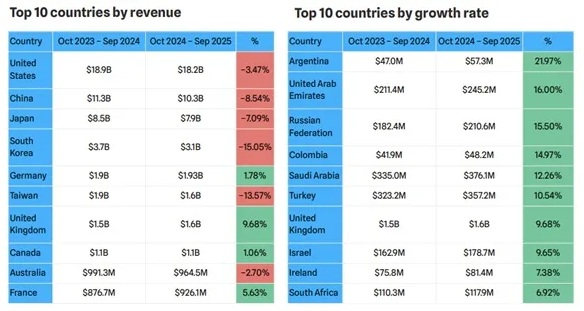
The regions with the strongest growth are concentrated in Latin America, Russia, the Middle East and Western Europe, with Argentina leading at a rate of $57.3 million (+21.97 per cent). Income in the United Arab Emirates increased by 16 per cent to $245.2 million; income in Russia increased by 15.5 per cent to $210.6 million.
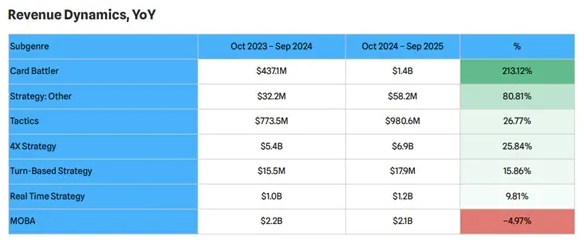
In the 12 months up to September, global strategic game income increased by 25.5 per cent over the year to $13.5 billion, of which App Store accounted for more than two thirds. In the strategic sub-category, the income from card games increased by 213.12 per cent to $1.4 billion the same year; the income from the leading sub-type 4X strategy games increased by 25.84 per cent to $6.9 billion; and the income from the MoBA game fell by 4.9 per cent to $2.1 billion. The income of the role-playing market fell by 15.35 per cent to $11.6 billion over the same period, of which Google Play fell by 13.6 per cent and App Store by 16.44 per cent. Most of the decline originated in the Eastern market, with China having the largest decline of 25 per cent. Of the RPG subtypes, Tactical RPG grew fastest, by 55.79 per cent over the same period, to $419.8 million; the most significant decline was in Wise RPG, by 28.17 per cent over the same period, to $682.2 million. The leading subcategory is the class of team combat, with revenues of $3.3 billion, a decrease of 14.39 per cent over the same period.
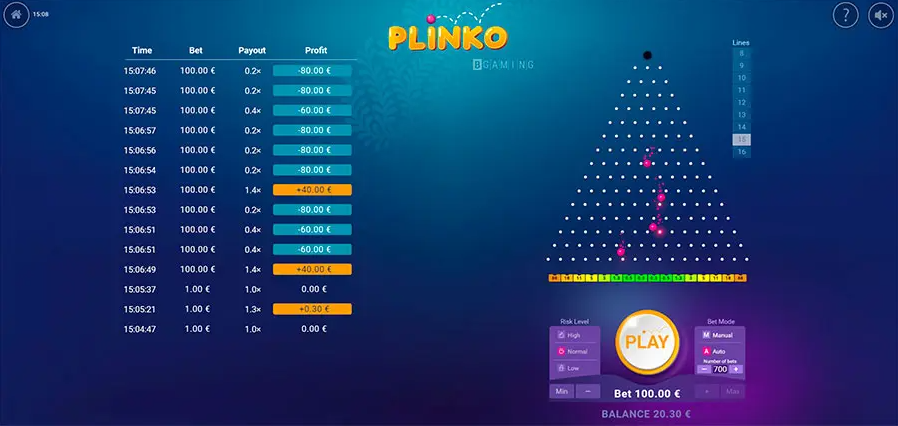
The income from the puzzle game market increased by 14.72 per cent over the same period to $8.8 billion. Growth has come mainly from first-tier market countries, such as the United Kingdom (+28) and Ireland (+24 per cent). The fallout continues to dominate, with income increasing by 4.13 per cent to $4.6 billion over the same period. The most significant increase was in the square puzzle game, with an increase of 911 per cent over the same year and an income of $156 million; the largest decline was in the search for different types of games, with a decrease of 42.56 per cent over the same year, to $2.2 million. Casino-like game-market revenues declined by 7.55 per cent to $7.2 billion per year, mainly as a result of the decline in first-class market revenues, most notably in the United States (-11 per cent). Tiger machine games remain the largest subtype, earning $2.6 billion, a decrease of 10.66 per cent over the same period. The revenue from marble games grew by 1061.09 per cent to $888 million; the decline was 39.66 per cent, to $750,000.
The income from simulation games increased by 11.24 per cent over the same period to $4.8 billion, of which App Store increased by 15.79 per cent. Sandboxes are the largest subtype, with an increase in income of 26.9 per cent to $1.4 billion over the year. Occupational simulations grew fastest, rising by 107.12 per cent to $14.5 million over the same period; and fishing simulations decreased most, by 40.26 per cent to $41.8 million over the same period. Combined leisure market income increased by 87.98 per cent over the same period, from $389.8 million to $732.7 million in the 12 months up to September.